Indoor air quality. Start with the cause.
Dust that keeps coming back. Air that feels too dry or damp. A room that never feels right. Tell us what you’re noticing—we’ll look at the HVAC side of the problem and explain what makes sense before recommending equipment.

You don’t need a product picked out.
Start with the concern. We’ll help separate what the equipment can address from what may need a different kind of attention.
Dust keeps coming back
You’re changing filters or cleaning surfaces, but still have questions about the air moving through your home.
Explore filtrationIt feels too dry or damp
You want to understand the humidity—not just buy a humidifier or dehumidifier and hope it helps.
Understand humidityA room feels stuffy
The temperature may look right on the thermostat, but the space still doesn’t feel comfortable.
Look at airflow and ventilationA product comes after the explanation.
EPA identifies three main ways to improve indoor air: address pollutant sources, improve ventilation, and add appropriate filtration. We use that same practical order of thinking—not an automatic add-on sale. [1]
Start with the source
Reducing or removing a source of pollution is often the most effective first step. [1] We’ll discuss what you notice and when it happens.
Understand the air path
We’ll look at the air-delivery system and discuss whether the concern calls for an airflow or ventilation evaluation. Those are not the same job.
Choose a suitable option
If we recommend a change, you’ll know what it is intended to address, what it will not do, and what maintaining it involves.
An HVAC visit is not a comprehensive test for every indoor pollutant. We’ll explain the scope and when a different specialist is needed.
Better filtration has to fit your system.
MERV ratings compare a filter’s ability to capture different particle sizes. Higher ratings generally capture more of the tested particles, but your system’s fan and filter slot still need to accommodate the filter. [2]
EPA recommends MERV 13, or the highest efficiency your system can accommodate, when upgrading filtration. [2] We’ll check suitability rather than recommend a rating in isolation.
What we’ll consider with you
- Your existing filter size, type, and fit.
- Airflow and the equipment’s filter requirements.
- Whether a central filter change or room-sized option matches the concern.
- Replacement availability, maintenance, and ongoing cost.
Particles and gases are different. A standard particle filter does not address every odor or gaseous pollutant. No filter removes everything. [3]
Measure it before changing it.
We’ll discuss where the problem occurs, when you notice it, and whether you have humidity readings or visible condensation. That gives the equipment conversation a starting point.
Humidification adds moisture; dehumidification removes it. We’ll explain which direction—if either—your home needs before recommending a change.
Moisture needs a cause addressed. A leak or wet building material is not solved by changing an air filter. Controlling moisture is central to controlling mold growth. [4]
EPA’s ideal indoor relative humidity range, when possible; it recommends staying below 60%. [4]
Condensation matters too. Don’t keep raising humidity to hit a number while windows or other surfaces stay wet. The home, season, and moisture conditions all belong in the discussion. [4]
This range is guidance, not a guarantee that condensation or moisture problems cannot occur.
See the finding. Understand the recommendation.
These are original photographs from our work. We’ll show you what we see in your equipment and explain what still needs to be checked—not use a photo alone to make a bigger claim.

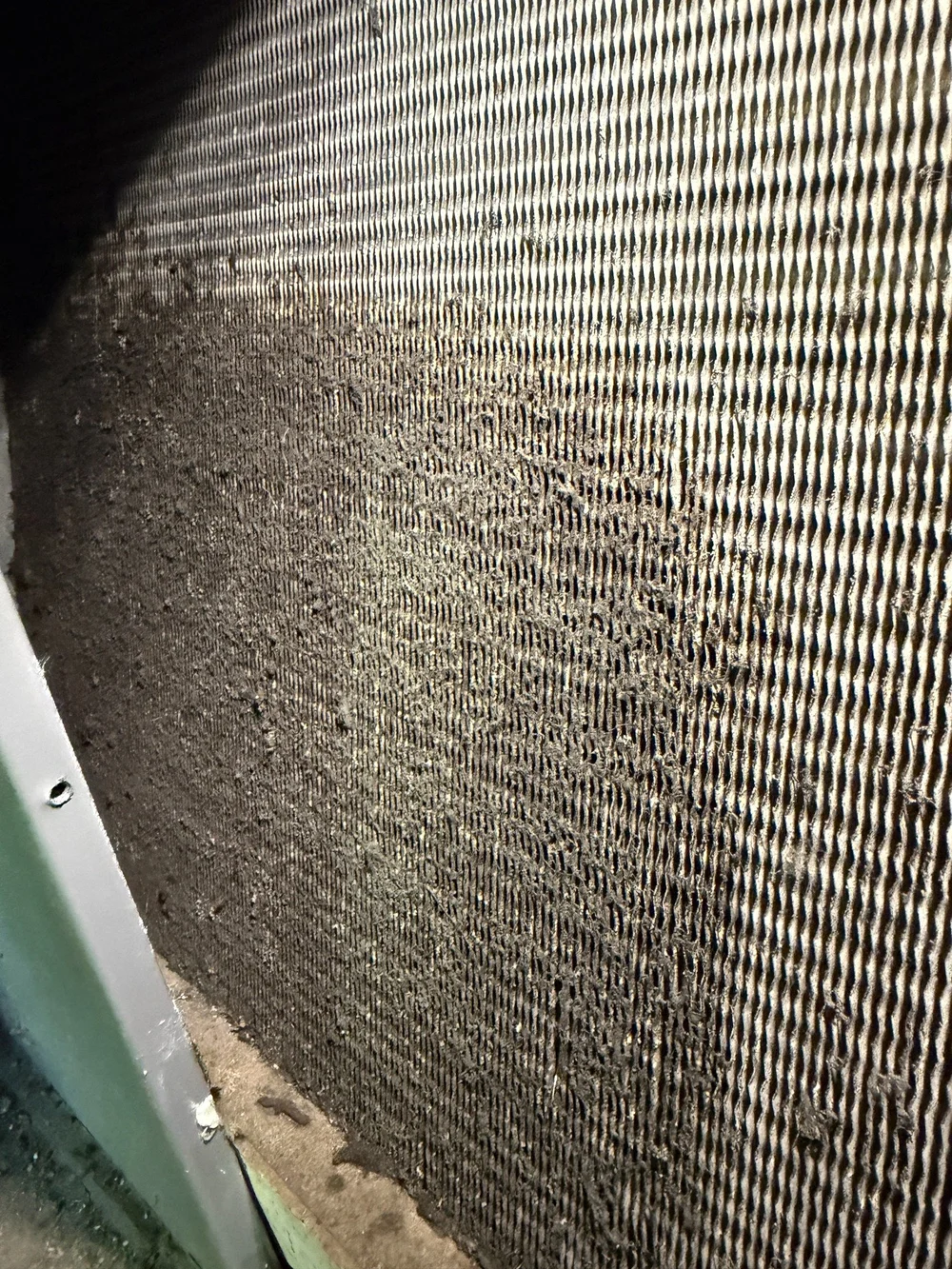
Moving air isn’t the same as bringing in fresh air.
Most residential forced-air systems recirculate indoor air rather than bring in outdoor air mechanically. Bathroom and kitchen exhaust that vents outdoors serves a different purpose. [1]
We’ll discuss room-to-room airflow, return paths, and ventilation separately. Bringing in outdoor air also requires attention to outdoor pollution and weather—not an instruction to open every window in every condition. [1]
Useful things to tell us
- Which rooms feel different, and at what times.
- Whether closed doors change the problem.
- When you notice odors or condensation.
- Any recent remodeling, leaks, or changes in how the space is used.
An observation helps us choose what to investigate. It is not a diagnosis on its own.
A conversation. An inspection. A clear next step.
We listen
Tell us what you want to improve and what you’ve already tried. Your experience shapes the visit.
We check what’s relevant
We agree on an HVAC-focused scope, then inspect the applicable equipment and take appropriate readings.
We explain the options
You’ll hear what we found, the limits of the checks, and the purpose and cost of any recommended work.
You decide
A filter change, another repair, a different evaluation, or no new equipment. We’ll explain why before you choose.
Understand the limits as well as the benefits.
Select a question to open its answer.
Should I buy the highest-MERV filter I can find?
Not without checking compatibility. The right choice is the highest suitable efficiency for the system—not simply the biggest number on a package. Follow the equipment’s filter requirements and replacement guidance. [2]
Do I need a whole-house air cleaner?
Not automatically. A properly sized portable cleaner can serve a room or area; central HVAC filters work on air moving through that system. Room size and clean air delivery rate matter for portable units. We’ll discuss the intended coverage. [3]
Will an air cleaner fix a musty smell or a moisture problem?
Not by itself. A persistent musty odor warrants investigating the source and moisture conditions. Filtration may capture some particles, but it does not repair a leak or resolve the underlying moisture problem. We won’t identify a substance as mold from its appearance in a photo. [3][4]
What about a device that intentionally makes ozone?
EPA warns that ozone can irritate the lungs and that ozone generators are not a safe, effective general solution for occupied homes. We would not recommend intentionally adding ozone to occupied living space as an air-cleaning strategy. [5]
Does an HVAC visit test for every indoor pollutant?
No. We’ll explain the HVAC checks included in the visit. Concerns involving a specific contaminant may need an environmental specialist or a different testing process. This service is not a medical assessment or a promise that the air is free of all pollutants.
Will you recommend equipment on every visit?
No. We’ll explain when a basic change, maintenance, or further investigation is the sensible next step. A product recommendation should have a clear purpose, not be the required outcome of the appointment.
Homeowner reference links
- EPA: sources, ventilation, and filtration
- EPA: MERV ratings and filter compatibility
- EPA: portable air cleaners and central HVAC filters
- EPA: moisture, humidity, and mold
- EPA: ozone-generating air cleaners
- Nicor Gas: gas-leak emergency guidance
- U.S. Consumer Product Safety Commission: carbon monoxide alarms
Let’s talk about what you’re noticing.
You don’t need to diagnose the air or choose a product first. Tell us what feels different, and we’ll help you understand the next step.